My Journey into Europa Universalis 5: A New Chapter Begins
 Jason Miller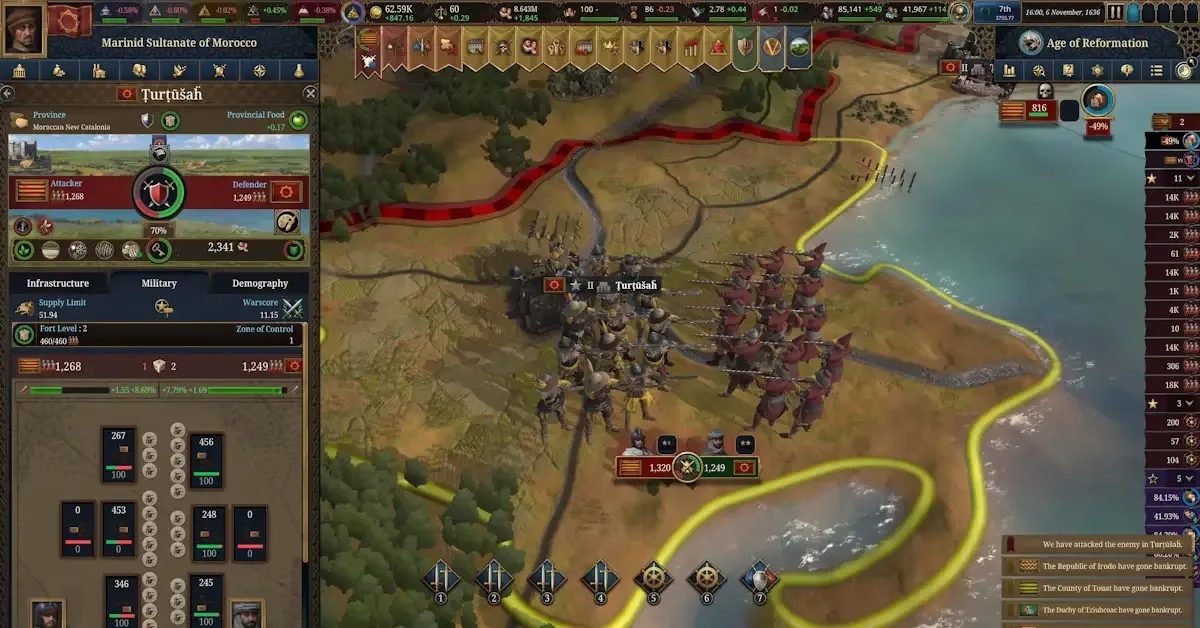
I still remember the exact moment I heard the news. It was an ordinary Tuesday afternoon when my Discord server exploded with notifications—Europa Universalis 5 had finally received its official release date. After more than a decade of waiting, wondering, and countless hours spent in EU4, the announcement felt surreal. November 4, 2025. I marked it on every calendar I owned.
The Weight of Twelve Years
Twelve years is a lifetime in gaming. When Europa Universalis 4 launched back in 2013, I was a completely different person. I'd poured what must have been thousands of hours into that game, guiding nations from obscurity to dominance, orchestrating marriages that would make medieval royalty jealous, and yes—painting that beautiful map in my nation's colors. The game had become more than just entertainment; it was my go-to escape, my digital history classroom, and occasionally, my greatest source of frustration when a coalition war went sideways.
Now, Paradox Interactive was promising to redefine the entire grand strategy genre once again. The ambition was staggering—a game that would take us from the late Middle Ages through to the dawn of modernity, with mechanics so deep and complex that early reviewers were already calling it "a new bar for complexity in the historical grand strategy genre." That phrase both thrilled and terrified me. 😰
Counting Down the Hours
As November approached, my excitement became almost unbearable. I started planning my launch day experience weeks in advance. Which nation would I choose for my first playthrough? The reliable Ottomans? A challenging Irish minor? Perhaps something completely different this time—maybe a nation in Southeast Asia I'd never seriously played before?
I obsessively checked the Steam page, reading and re-reading the system requirements. My PC, which had faithfully served me through countless EU4 campaigns, would need to prove itself worthy once more. Fortunately, the 15 GB file size was surprisingly modest—I'd expected something far more demanding given the scope of improvements Paradox was promising.
The announcement that preloading would begin 24 hours before launch was music to my ears. I set multiple alarms to ensure I wouldn't miss it. My internet connection isn't the fastest, and the thought of spending launch day staring at a download bar instead of rewriting history was unacceptable.
A Global Launch Experience
What fascinated me about the launch was its truly global nature. While most of us would start our campaigns on November 4th, I had friends in China, Japan, and Korea who would technically be loading the game in the early hours of November 5th. We joked about them "living in the future," getting first dibs on discovering the new mechanics and hidden gems that EU5 would surely contain. Part of me envied them, but mostly I was just excited that we'd all be diving in within hours of each other, regardless of timezone. 🌏
The weeks leading up to launch were filled with speculation and discussion. Forum threads debated what the "new mechanics" would entail. Would diplomacy finally feel as nuanced and consequential as real-world international relations? How would the "ambitious global simulation" differ from what we'd experienced before? Every dev diary, every screenshot, every tiny piece of information was dissected and analyzed by our community with the intensity of Renaissance scholars examining ancient texts.
More Than Just Map Painting
One thing that always separated Europa Universalis from other strategy games was how it transcended simple conquest. Sure, expanding your borders was satisfying—there's an undeniable pleasure in seeing your nation's color spread across the map. But the real magic happened in the moments between wars: the careful diplomatic dance of securing alliances, the economic decisions that could make or break your empire, the religious tensions that could tear your nation apart from within.
EU5 promised to take this living, breathing history simulator to new heights. The idea that my decisions would "ripple through centuries" wasn't just marketing speak—it was the core promise of what made this series special. Every choice mattered. Every alliance, every trade agreement, every declaration of war would cascade forward, creating emergent narratives that no scriptwriter could have predicted. 📜
I thought about some of my most memorable EU4 moments: that time I united Ireland against all odds, the campaign where I turned Brandenburg into an industrial powerhouse, the disastrous attempt to play as Byzantium that ended in complete collapse by 1500. Each campaign had taught me something new, not just about the game, but about history itself—the complex web of factors that shaped our world.
Preparing for the Deep Dive
As launch day approached, I started preparing mentally for what I knew would be a significant time investment. My friends and family were already aware that I'd be somewhat unavailable for the first week after release. My partner, bless them, had even jokingly scheduled their own activities to give me space. "I know how you get with these games," they'd said with a knowing smile. They weren't wrong. 😅
I stocked up on snacks, cleared my schedule as much as possible, and even did a final campaign in EU4 as a sort of farewell to the old game. It felt appropriate—like closing one chapter before beginning another. That game had given me so much over the years, and while I knew I'd occasionally return to it, EU5 was clearly going to become my new obsession.
The promise of "deeper diplomacy" particularly excited me. In EU4, diplomacy sometimes felt like a means to an end—a way to secure alliances before the inevitable wars. But what if it could be more? What if diplomatic victories felt as satisfying as military ones? What if you could truly reshape the world through words and treaties rather than just armies and navies?
The Paradox of Expectation
Being a Paradox veteran comes with its own set of mixed feelings. I'd lived through enough DLC cycles and post-launch patches to know that the game at release would likely be different from the game it would become in a year or two. The community likes to joke that Paradox games aren't truly "finished" until they've had several years of development and a dozen DLCs. 🎮
But there's something special about being there at the beginning. Discovering mechanics before the meta becomes established. Finding those hidden gem nations that YouTubers haven't made famous yet. Experiencing the game in its purest form, before guides and wikis have mapped out every optimal strategy.
I'd already seen people in forums debating whether to wait for the first few patches or dive in immediately. For me, there was no question—I'd be there on day one, bugs and balance issues be damned. Part of the journey is figuring things out together with the community, sharing discoveries, warning others about potential exploits or broken mechanics.
A New Age of Strategy
Now, here in 2026, looking back at that November 4th launch, I can barely remember what I was worried about. The game exceeded my expectations in ways I couldn't have imagined. Sure, there were some rough edges at launch—there always are—but the core experience was everything I'd hoped for and more.
The complexity that reviewers had warned about? It felt less like overwhelming difficulty and more like satisfying depth. Every system interlocked with others in meaningful ways. Trade routes affected diplomatic relations. Religious tensions influenced military readiness. Economic prosperity determined cultural development. It was the kind of interconnected simulation that made you feel like you were truly guiding a nation through history rather than just playing a game.
For newcomers to the series, EU5 has actually proven more accessible than many feared. Yes, there's a learning curve—there has to be with something this ambitious. But the tutorials are more comprehensive, the UI more intuitive, and the community more welcoming than ever. I've spent hours on Discord helping new players navigate their first campaigns, and seeing their excitement when things finally click never gets old. 🎓
Which Nation Will You Choose?
The question that dominated launch day discussions—"Which nation will you play?"—still sparks passionate debates. Some prefer the major powers, guiding established empires to even greater glory. Others seek out challenging minors, turning historical footnotes into alternative history success stories. There's no wrong answer, and that's part of what makes this series endlessly replayable.
My first campaign was with Portugal. Not the most exotic choice, but I wanted something familiar enough to learn the new systems without being overwhelmed. The Age of Discovery mechanics were absolutely incredible—sending explorers into unknown waters felt genuinely exciting, like I was participating in one of history's great adventures. When my conquistadors first made contact with civilizations across the Atlantic, I felt that same sense of wonder I'd experienced years ago when first discovering this genre.
Europa Universalis 5 hasn't just dominated the grand strategy scene—it's reminded us why we fell in love with these games in the first place. Whether you're orchestrating complex diplomatic marriages, commanding armies across continents, or carefully managing trade networks, every session offers something new. Every campaign tells a different story. Every decision creates ripples that echo through centuries.
As I prepare to launch my next campaign—I'm thinking Burgundy this time, with plans to dominate European trade—I'm reminded why games like this matter. They're not just about winning or losing. They're about experiencing the weight of history, understanding the complexity of human civilization, and occasionally, spectacularly failing when that coalition you didn't see coming decides you've gotten too powerful. 😂
The journey continues, the map awaits, and somewhere out there, a small nation is waiting for someone to guide it to unexpected glory—or inevitable ruin. That's the beauty of Europa Universalis 5: the story is always yours to write.
