Slay the Spire 2: The Deckbuilder That Rewrote Gaming History
 Mark Stevens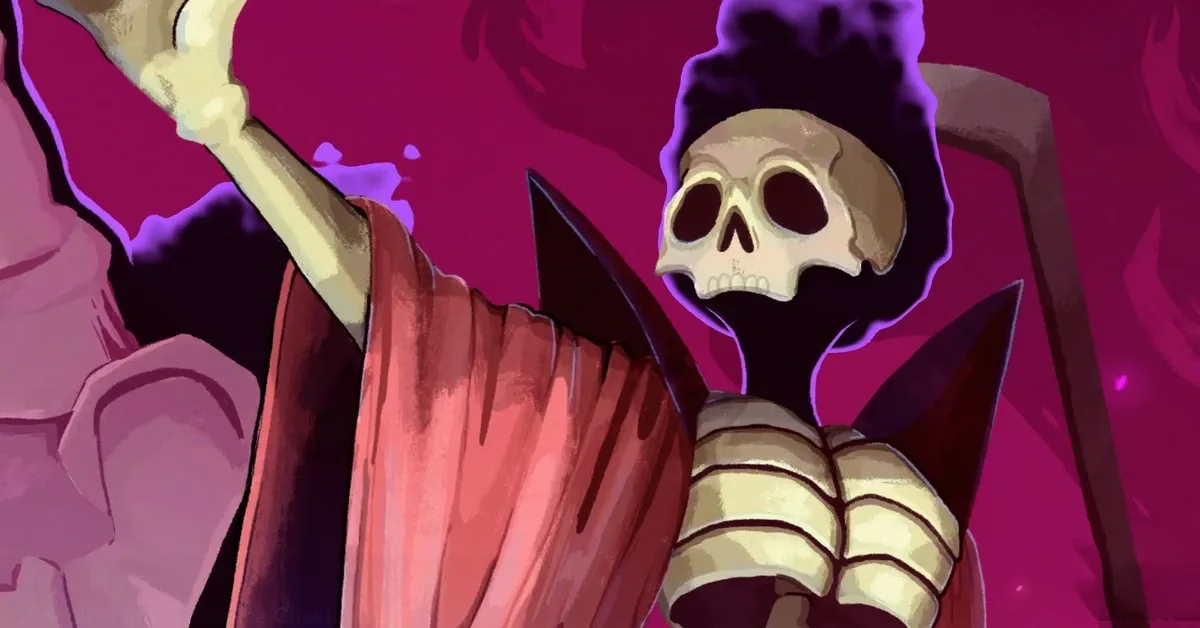
In the bustling world of digital card games, a titan emerged from the shadows of its legendary predecessor, and the gaming community watched in awe as records crumbled like ancient ruins. The spring of 2026 witnessed something extraordinary—a sequel that didn't just meet expectations but obliterated them with the force of a perfectly executed combo.
A Storm of Success That Defied All Predictions
The numbers told a story that even the most optimistic forecasters hadn't dared to predict. Within a single week of its launch, Slay the Spire 2 had captured the hearts and wallets of over three million players worldwide. This wasn't merely a successful sequel; it was a phenomenon that sent shockwaves through the entire deckbuilding genre. Developer Mega Crit had taken a gamble, and the cards had fallen spectacularly in their favor.
The metaphorical lightning that struck with the original Slay the Spire's release years ago had returned with exponentially greater intensity. Critics who had wondered whether Mega Crit could recapture the magic found their skepticism transformed into unbridled enthusiasm. The studio hadn't just caught lightning in a bottle twice—they had harnessed the entire storm.
The Engine That Changed Everything
Beneath the surface of those impressive sales figures lay a technical revolution that purists and casual players alike could appreciate. The decision to migrate from Unity to the Godot engine represented more than just switching tools—it was a complete reimagining of what the game could achieve. The transition enabled animations that flowed with buttery smoothness, card interactions that felt responsive and immediate, and a level of visual polish that the original could only dream of achieving.
Players descending into the Spire's depths found themselves immersed in an experience that felt simultaneously familiar and thrillingly novel. 🎮 The core loop that had defined countless late-night gaming sessions remained intact, but every aspect had been refined, polished, and enhanced. Veterans of the original game discovered that muscle memory from hundreds of hours of play translated perfectly, yet fresh mechanics kept them on their toes.
Innovation Through Refinement
Where lesser sequels might have fallen into the trap of feature bloat, Slay the Spire 2 demonstrated masterful restraint. The introduction of the Necrobinder class opened entirely new strategic avenues without overwhelming the game's elegant core design. This mysterious new character brought death-themed mechanics that intertwined beautifully with existing systems, creating synergies that felt discovered rather than designed.
But the real game-changer came in an unexpected form: cooperative multiplayer. The experimental 4-player co-op mode fundamentally altered the genre's DNA. 🎲 What had traditionally been a solitary climb now became a shared adventure, where strategic coordination and complementary deck construction could mean the difference between triumph and defeat.
The Epochs System: A Revolutionary Progression Framework
Perhaps the most elegant innovation came in the form of the Epochs system. This mechanic transformed the roguelike formula's traditional "every run is isolated" philosophy into something more emotionally resonant. Each failed attempt at conquering the Spire now contributed to a larger narrative of progression.
The psychological impact proved profound—what once might have felt like a crushing defeat now registered as a meaningful step forward. Players reported feeling motivated to continue even after particularly brutal runs, knowing that their efforts accumulated toward long-term goals. It was the kind of systemic brilliance that separated good games from generational classics.
Numbers That Stunned the Industry
The raw data emerging from Steam's servers painted a picture of unprecedented success. 📊 Within mere days of the March 2026 launch, concurrent player counts soared to heights that seemed almost impossible:
-
Peak Concurrent Players: 574,638
-
Comparison to Original: 10x higher than Slay the Spire's peak
-
Genre Dominance: Crushed every competing deckbuilder's records
-
Estimated Total Sales: 4.6 million copies
-
Revenue Generated: Over $92 million in opening weeks
These weren't just good numbers—they were category-redefining statistics. Industry analysts scrambled to contextualize what they were witnessing. Comparisons to other genre leaders like Balatro only served to emphasize the gap: Slay the Spire 2's peak was more than thirteen times higher. The message was clear: this wasn't competition; this was domination.
The Market Impact
Newzoo, one of the gaming industry's most respected analytics firms, didn't mince words in their assessment. Their analysts declared it "a category-defining moment," recognizing that the landscape of deckbuilding games had fundamentally shifted. Other developers in the space found themselves forced to recalibrate their expectations and strategies.
The Early Access Paradox
One of the most remarkable aspects of Slay the Spire 2's success was its launch state. The game entered Early Access—typically a label associated with incomplete, buggy experiences that require patient players willing to weather technical storms. Yet this Early Access release defied all conventions.
Players discovered a product that was more stable, more polished, and more feature-complete than many fully released titles they'd purchased at full price. The depth of content available from day one was staggering:
-
Multiple fully realized character classes
-
Hundreds of unique cards with intricate interactions
-
A robust progression system
-
The innovative co-op mode
-
Countless enemy types and boss encounters
Streamers who dove into the game during launch week found themselves still discovering new strategies and combinations weeks later. The replayability factor—already the original game's strongest asset—had been amplified to absurd levels. 🔄
A Study in Genre Evolution
What set Slay the Spire 2 apart from the countless deckbuilder clones that had flooded the market wasn't a single revolutionary feature but rather an understanding of what made the genre sing. While competitors added systems upon systems, creating Frankenstein's monsters of gameplay mechanics, Mega Crit focused on synergy.
Each card, each relic, each character ability was designed to interact with others in meaningful ways. The game rewarded creativity and experimentation while maintaining enough structure to prevent complete chaos. It was a delicate balance that most developers struggled to achieve, yet Mega Crit made it look effortless.
The Competition's Response
In the wake of Slay the Spire 2's launch, the broader deckbuilding community found itself at a crossroads. Some developers viewed the sequel's success as validation of the genre's potential, inspiring them to push their own projects harder. Others recognized the harsh reality: the bar had been raised to potentially unreachable heights.
Forums and social media platforms buzzed with discussions comparing other deckbuilders to the new standard. Games that had previously received praise suddenly found themselves criticized for lacking the polish, depth, or innovation that Slay the Spire 2 delivered effortlessly. It was a rising tide that lifted some boats while capsizing others.
The Value Proposition
💰 For players weighing whether to invest in the game, the mathematics were compelling. With months of content available even in its Early Access state, the cost-per-hour entertainment value dwarfed most alternatives. Strategic shoppers tracking price comparisons across various platforms could find deals that made the already reasonable asking price even more attractive.
The promise of continued updates and additions during the Early Access period only sweetened the proposition. Unlike many games that launched in "complete" states and received minimal post-launch support, Slay the Spire 2 came with the explicit guarantee of growth and refinement.
Looking Forward: The Spire's Shadow
As 2026 progressed, the question facing the gaming industry wasn't whether Slay the Spire 2 would succeed—that question had been answered emphatically in its opening weeks. Instead, observers wondered what the game's dominance meant for the future of deckbuilders and roguelikes more broadly.
Would other developers attempt to chase the Spire's shadow, iterating on its innovations? Or would they recognize that competing directly was futile, instead seeking unexplored niches within the broader genre? The answers would shape the gaming landscape for years to come.
What remained undeniable was that Mega Crit had achieved something rare in an industry obsessed with bigger, flashier, more expensive productions. They had proven that understanding your audience, respecting your game's core identity, and relentlessly pursuing quality could still triumph over bloat and bombast. 🏆
The tower stood taller than ever, and millions of players worldwide were eager to attempt the climb, failure after failure, victory after victory, always reaching for that next perfect run. In that endless loop of challenge and reward, Slay the Spire 2 had found not just commercial success but gaming immortality.
